
Meta | Space Fireplace Services
Space Fireplace Services — DFW chimney & fireplace specialists. Free inspection, written quote, no surprise fees.
Meta
Title (60ch):Gas Conversion">Wood-to-Gas Conversion — Process, Specification, Code Description (150ch): A specification guide for converting an existing wood-burning fireplace to gas: insert vs. log set, venting, code, and design integration.—
Wood-to-Gas Conversion — Process and Specification
*By the Space Fireplace Services Atelier — Updated May 8, 2026*
The conversion of an existing wood-burning fireplace to gas is one of the most common projects in our atelier. The reasons vary — buyers of older Dallas homes who want the firebox usable on a switch, owners of period homes who want to retain the architectural language while gaining convenience, designers updating a contemporary home where wood was specified but never quite suited the use case. The technical decisions are straightforward when properly specified.
TL;DR — A working summary
Wood-to-gas conversion has three primary specifications: gas log set in the existing wood firebox (most affordable, retains the firebox visually), gas insert in the existing firebox (sealed combustion, higher efficiency, modified appearance), and complete firebox replacement with a new gas unit (most flexible, used when the existing firebox is undersized or damaged). Each requires a chimney inspection, gas line, and code compliance. Lead times: 4–10 weeks. Investment: $4,500–$–+ depending on scope.
The three primary approaches
1. Vented gas log set
A set of ceramic logs with a burner, installed inside the existing wood firebox. Uses the original chimney and damper.
- **Best for:** preserving the original wood firebox visually, modest budget, period homes
- **Pros:** retains firebox character, reversible, lower cost
- **Cons:** less efficient (warm air goes up the flue), damper must remain open during use
2. Direct-vent gas insert
A sealed combustion unit installed inside the existing firebox, with its own intake and exhaust running up the existing chimney. The original firebox becomes a frame; the insert provides the actual fire.
- **Best for:** higher efficiency, modern function, owners who use the fireplace regularly
- **Pros:** sealed combustion (better efficiency), flames visible behind glass, controllable
- **Cons:** changes the visual character of the original firebox, glass front rather than open fire
3. Full firebox replacement
The existing firebox is removed and a new gas unit (often linear contemporary) is installed in its place.
- **Best for:** modernization projects, contemporary aesthetics, situations where the original firebox is failing
- **Pros:** complete design flexibility, contemporary linear and modern shapes available
- **Cons:** highest cost, structural and design coordination, often eliminates the original architectural language
The conversion process
Step 1 — Inspection
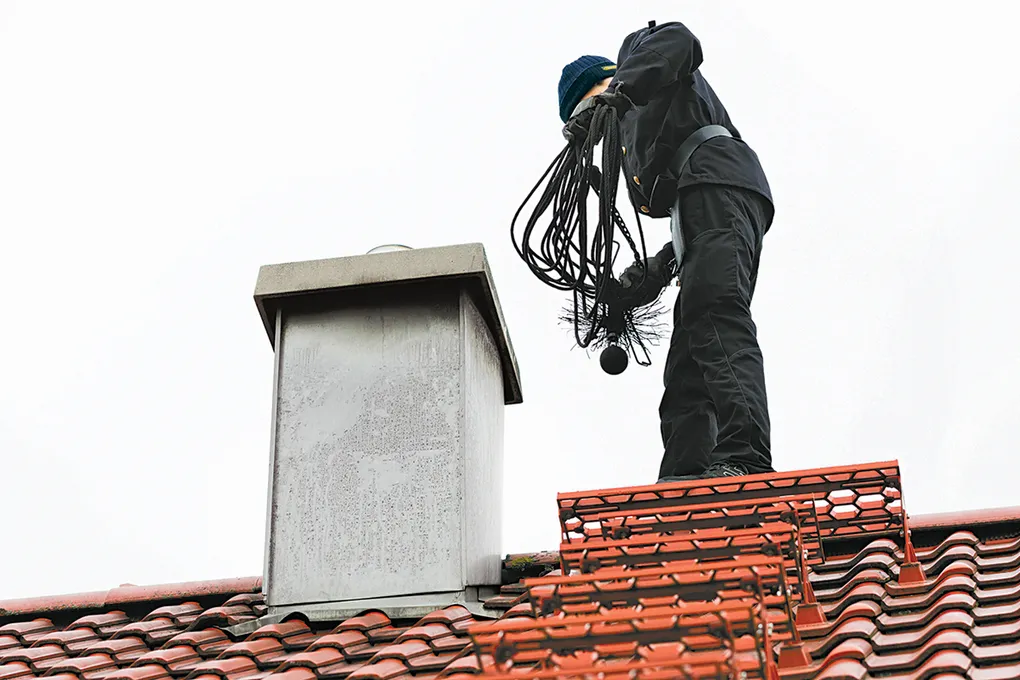
A Level 2 chimney inspection by a CSIA-certified sweep confirms the existing chimney is sound and appropriate for the planned conversion. This includes:
- Video scope of the flue
- Examination of the firebox condition
- Damper inspection
- Cap, crown, and flashing review
If the chimney needs work — relining, crown rebuild, or other masonry — that’s specified before conversion.
Step 2 — Specification
Based on the inspection and homeowner goals:
- Type of conversion (log set, insert, full replacement)
- Specific product selection
- Surround treatment (existing, modified, or replaced)
- Gas line route from meter or appliance trunk
- Electrical for ignition (if not millivolt)
- Control system
- Smart-home integration (where applicable)
Step 3 — Permits
Mechanical and gas permits are pulled with the local municipality. Highland Park, University Park, and most DFW cities require both for any gas appliance installation.
Step 4 — Procurement
Lead times for premium gas units are 6–14 weeks. Procurement is initiated as soon as specification is finalized.
Step 5 — Installation
- Gas line extension to the firebox location
- Pressure test
- Existing firebox preparation (cleaning, masonry repair if needed)
- Unit installation
- Vent connection (using existing chimney for log sets and inserts; new vent for some replacements)
- Electrical for ignition
- Control system installation
- Surround integration (if modified)
Step 6 — Inspection and commissioning
- Municipal inspection
- Pressure test verification
- First-light test with verification of proper combustion
- Walk-through with homeowner
Comparison: Investment by approach
| Approach | Investment range | Timeline | Best for |
|—|—|—|—|
| Vented log set | $2,500–$–+ | 2–4 weeks | Period preservation, modest budget |
| Direct-vent insert | $6,500–$–+ | 4–8 weeks | Modernization, regular use |
| Full firebox replacement | $15,000–$–+0+ | 6–12 weeks | Contemporary redesign, design flexibility |
| Conversion in estate-grade restoration | $25,000–$–+0+ | 12–20 weeks | Architectural preservation with modern function |
Maintaining the architectural language
For period homes — Tudor, French eclectic, Colonial Revival — the conversion can be done sympathetically to preserve the architectural intent:
- **Use a vented log set in the original firebox.** The firebox itself remains; the gas logs sit where the wood logs would.
- **Specify ceramic logs that read correctly.** Hand-painted ceramic logs in oak or birch patterns are convincing at normal viewing distance.
- **Conceal controls.** Wall switches recessed into adjacent millwork or paneling. Remote-only operation. No visible touchpad on the firebox.
- **Maintain the damper.** Even with a vented log set, the damper is operated normally — closed when not in use, open during use.
- **Preserve the surround.** No modifications to the original surround unless restoration is part of the project.
For contemporary homes, the design conversation is different — the fireplace can be redesigned as a feature element with a linear or contemporary unit replacing the original entirely.
Code considerations
Across DFW:
- Permits required for nearly all conversions
- Direct-vent units strongly preferred over vent-free
- Vent-free units restricted in most Dallas-area municipalities
- Gas line must be properly sized for the appliance load
- CO detector required in the home
- Manual gas shutoff within reach of the appliance
When to call us
For wood-to-gas conversion specification, product selection, and installation, we work directly with homeowners, designers, and architects. By appointment.
Call 469-992-4912.
FAQ
Can any wood fireplace be converted to gas?Most can. The chimney must be inspected and may need relining; the firebox dimensions must accommodate the chosen unit; gas service must be available.
Do I lose the wood-burning option?With a vented log set, no — the burner sits in the firebox and can theoretically be removed. With an insert or full replacement, the wood-burning capability is replaced.
How efficient is a gas conversion compared to wood?A direct-vent insert is significantly more efficient (50–80% efficiency) than an open wood fire (5–15% efficiency for warming the room).
What about smart-home integration?Standard for premium installations. Lutron, Crestron, Control4, and Savant all integrate with appropriate gas units.
Can I have flames as realistic as wood?Premium gas units produce convincing flames at normal viewing distances. Direct comparison with a wood fire reveals differences, but standalone the gas fire reads as fire.
How long does the conversion take from start to finish?4–10 weeks from initial inspection to commissioning, depending on scope and procurement.
Is the conversion reversible?Vented log sets are largely reversible. Inserts and full replacements are not — they modify the firebox.
Visit by appointment
Call 469-992-4912 to schedule a consultation.
—
Internal links
- [Gas Conversion Service](https://spacefireplaceservices.com/gas-conversion/)
- [Linear Fireplace Service](https://spacefireplaceservices.com/linear-fireplace/)
- [Specifying Linear Fireplace](https://spacefireplaceservices.com/learn/specifying-linear-fireplace-architect-guide/)
- [Ventless vs Direct-Vent TX Code](https://spacefireplaceservices.com/learn/ventless-vs-direct-vent-fireplace-tx-code/)
- [frisco/" class="auto-entity-link" data-term="Newman Village">Newman Village Frisco](https://spacefireplaceservices.com/areas/newman-village-frisco/)
—
JSON-LD
“`json
{
“@context”: “https://schema.org”,
“@graph”: [
{“@type”: “Article”, “headline”: “Wood-to-Gas Conversion — Process and Specification”, “author”: {“@type”: “Organization”, “name”: “Space Fireplace Services Atelier”}, “publisher”: {“@type”: “Organization”, “name”: “Space Fireplace Services”, “telephone”: “☎ 469-992-4912”}, “datePublished”: “2026-05-08”, “dateModified”: “2026-05-08”, “mainEntityOfPage”: “https://spacefireplaceservices.com/learn/wood-to-gas-conversion-process-dallas/”},
{“@type”: “FAQPage”, “mainEntity”: [{“@type”: “Question”, “name”: “Can any wood fireplace be converted?”, “acceptedAnswer”: {“@type”: “Answer”, “text”: “Most can. Chimney must be inspected, firebox dimensions must accommodate the unit, gas service must be available.”}}, {“@type”: “Question”, “name”: “Is the conversion reversible?”, “acceptedAnswer”: {“@type”: “Answer”, “text”: “Vented log sets are largely reversible. Inserts and full replacements are not.”}}]},
{“@type”: “BreadcrumbList”, “itemListElement”: [{“@type”: “ListItem”, “position”: 1, “name”: “Home”, “item”: “https://spacefireplaceservices.com/”}, {“@type”: “ListItem”, “position”: 2, “name”: “Learn”, “item”: “https://spacefireplaceservices.com/learn/”}, {“@type”: “ListItem”, “position”: 3, “name”: “Wood-to-Gas Conversion”, “item”: “https://spacefireplaceservices.com/learn/wood-to-gas-conversion-process-dallas/”}]}
]
}
“`
Our Sister Companies — Specialists in Related Services
Texas Service Experts is part of a network of CSIA-certified chimney specialists. Depending on your specific need:
- Texas Service Experts — general chimney sweep/inspection
- Texas Chimney Experts — chimney repair/masonry