
Chimney Liner
The hidden detail that lets your centerpiece burn clean and draw beautifully.
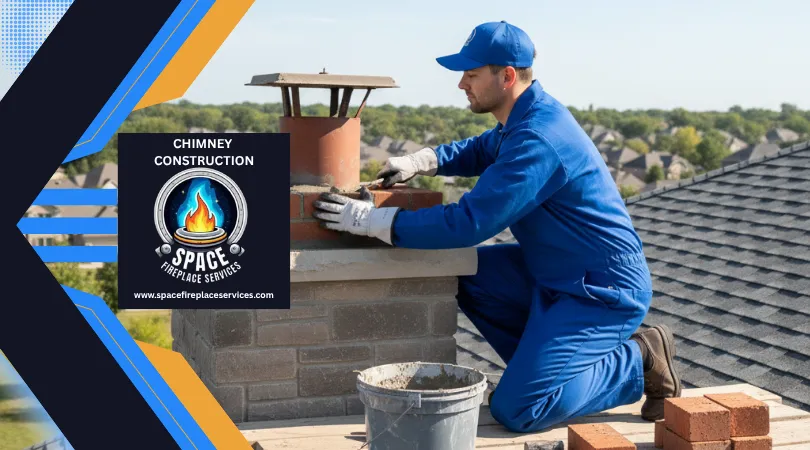
Learn moreWhere the chimney meets the roof is both the most common leak point and a line that should look clean and intentional — not smeared with caulk. We install proper two-layer step and counter-flashing, cutting new reglets into the masonry so the metal tucks in crisply and sheds water for good. A caulk-only patch fails within a couple of years and always looks like a patch; done right, the transition disappears into the roofline. The real win is keeping water away from the masonry and the firebox it feeds inside.
The watertight transition where chimney meets roof is the leak point homeowners least suspect and contractors most often botch. Built correctly it's a two-part system: step flashing — individual L-shaped pieces woven course by course into the shingles up the sidewall — and counter-flashing set into a saw-cut reglet in the masonry and folded down over those step pieces. Built wrong, it's a bead of caulk smeared across a gap, the exact "repair" that fails inside a season and drives water into the structure. We flash chimneys as the layered, mechanical, watertight assembly they're meant to be, because all the brick waterproofing in the world means nothing while the roofline transition stays open.
We diagnose first, then repair to the right depth. A sound flashing system with a failed seal may want nothing more than the reglet reservoir re-tooled and re-sealed; a corroded or badly installed one has to come out entirely and be rebuilt — new step flashing woven into the shingles, new counter-flashing cut into a fresh reglet, lead or aluminum to suit the roof. We dress fatigued lead back down, solder copper and galvanized corners into a watertight non-caulk joint where the detail demands it, and drill weep holes where water is trapped in the masonry cavity. On a wide chimney, or one sitting in a roof dead-valley that ponds water, more flashing isn't the answer — a cricket is: a peaked metal or framed saddle built on the uphill side that diverts water and debris around the stack rather than letting it dam against the back wall. Where the wood cant or substrate beneath the cricket has rotted, we replace it before re-metaling, since new flashing over rotted backing is a guaranteed callback.
Flashing failures hide in the harder roof geometries — and that's exactly where most contractors are out of their depth. A chimney in a dead-valley, the low spot where two roof planes funnel water toward it, will pond and leak no matter how clean the step flashing looks, and the real remedy is a diverter that moves the water off before it ever reaches the stack. Water trapped inside a masonry cavity needs weep holes drilled at the flashing line to drain it, or it just sits and finds another way in. A counter-flashing reglet needs its sealant tooled into a properly backed reservoir rather than smeared across the surface, or it peels away as the building moves. On a flat commercial roof, an irregular stack penetration may call for a poured pitch pan instead of conventional flashing altogether. We diagnose the geometry, not just the metal, because the leak is so often a water-management problem the original flashing was never designed to solve.
On a flashing joint there's no partial credit — the craftsmanship is either watertight or it isn't. We document the condition, lay out honestly whether a reseal or a full replacement is warranted, and build the transition to shed water for the long term instead of buying a single season with sealant. The same flashing-and-cricket standard governs every centerpiece we're trusted with, and crickets are specified wherever chimney width or roof geometry actually demands one rather than tacked on as an upsell. Get the roofline transition right and you've sealed the leak point that defeats every other waterproofing measure — which is precisely why we treat flashing as the precision work it is, not the caulk-gun afterthought it's so often reduced to.
At Space Fireplace Services, a chimney flashing repair is never guesswork. We scope every job from a graded, photographed inspection first — the NFPA 211 level the evidence calls for — so the work is matched to what your flue and masonry actually need, with the report to prove it. The documented inspection is the record the chimney flashing repair is built on.
Chimney inspectionA chimney flashing repair isn't a matter of opinion — it's held to published national standards. Space Fireplace builds every job to the named codes below and documents it, so the work is provably right for an inspector, an insurer, or a future buyer. These are the universal standards; your city's permit and inspection requirements are confirmed with the local authority before we pull the job.
Done to code, the flashing transition is built in two parts: step flashing woven into the shingles course by course, then counter-flashing let into a reglet saw-cut into the masonry. A bead of roofing tar has no place in that assembly.
Where a chimney runs wide or sits in a roof dead-valley, we build a cricket, also called a saddle, on the up-slope side to steer water and debris around the stack. It is the accepted remedy when roof slope and chimney width let water dam against the back wall.
Our counter-flashing is mechanically set into a backed reglet reservoir and sealed there, which keeps the joint watertight through the building's natural movement. Surface caulk, by contrast, pulls away within a season.
Codes cited are the established national standards (NFPA, UL, IRC) that govern this service. The adopted code edition, permit, and inspection requirements vary by city —Space Fireplace verifies them with your local authority having jurisdiction on every job.
Pinpoint the leak path at the chimney-to-roof junction.
Strip failed flashing and any tar patches.
New step + counter-flashing, set and sealed watertight.
Water-test the repair and document with photos.
We've worked on 1,000+ DFW homes over 10+ years. Every job — small sweep or full rebuild — runs the same way: certified technicians, written quotes, photo reports, warranty in writing.
Proper step + counter-flashing, not a tar band-aid
Counter-flashing set into the mortar joint
Stops the leak at the source, guaranteed
Coordinates with roof line for a clean finish
Family-owned, CSIA-certified, NFPA 211–compliant. We're the team you call when you want it done right the first time — no rotating subcontractors, no upsell pressure, no surprises. Same techs, same trucks, same standard.
Plan on a Level 1 inspection every year — that's the NFPA cadence — with an actual sweep once buildup reaches 1/8" of creosote. For a fireplace you light through the season, that usually lands at once a heating season. Think of it as the upkeep that keeps the centerpiece of the room clean, drawing well, and ready to look its best.
Yes. The inspectors who assess your chimney hold current CSIA (Chimney Safety Institute of America) certifications — you can confirm them in the CSIA member directory at csia.org — and our fireplace installations are handled by NFI specialists. The craft that makes a hearth a showpiece starts with the people standing in front of it.
Yes — emergency response is available 24/7 (subject to crew availability) for active water leaks, an animal trapped in the flue, post-fire damage, and storm damage, same-day in most cases. A fireplace is the heart of a room; when it's at risk, we treat it that way.
Always. You get a written quote before a single tool comes out, with photos of exactly what we found. Final pricing tracks the chimney's real condition and anything additional the inspection surfaces — no surprises, just a clear picture of what your fireplace needs.
Yes — our annual maintenance membership runs $19.99/month ($240/year) and covers a yearly Level 1 inspection and sweep ($248 value), priority scheduling, 10% off all repairs, and emergency-response priority. Cancel anytime, no contract. It's the quiet way to keep your hearth looking and working its best year after year.
Last reviewed:
Other services in the Repair category.
Free written quote. Same-week scheduling. 24/7 emergency response when you need it.
Active leak, animal in flue, post-fire damage, or smoke event? Real humans on the line 7 AM to 12 AM every day — replies in under 2 minutes. Tech dispatch within 2 hours during business hours, subject to crew availability after-hours.
Emergency line